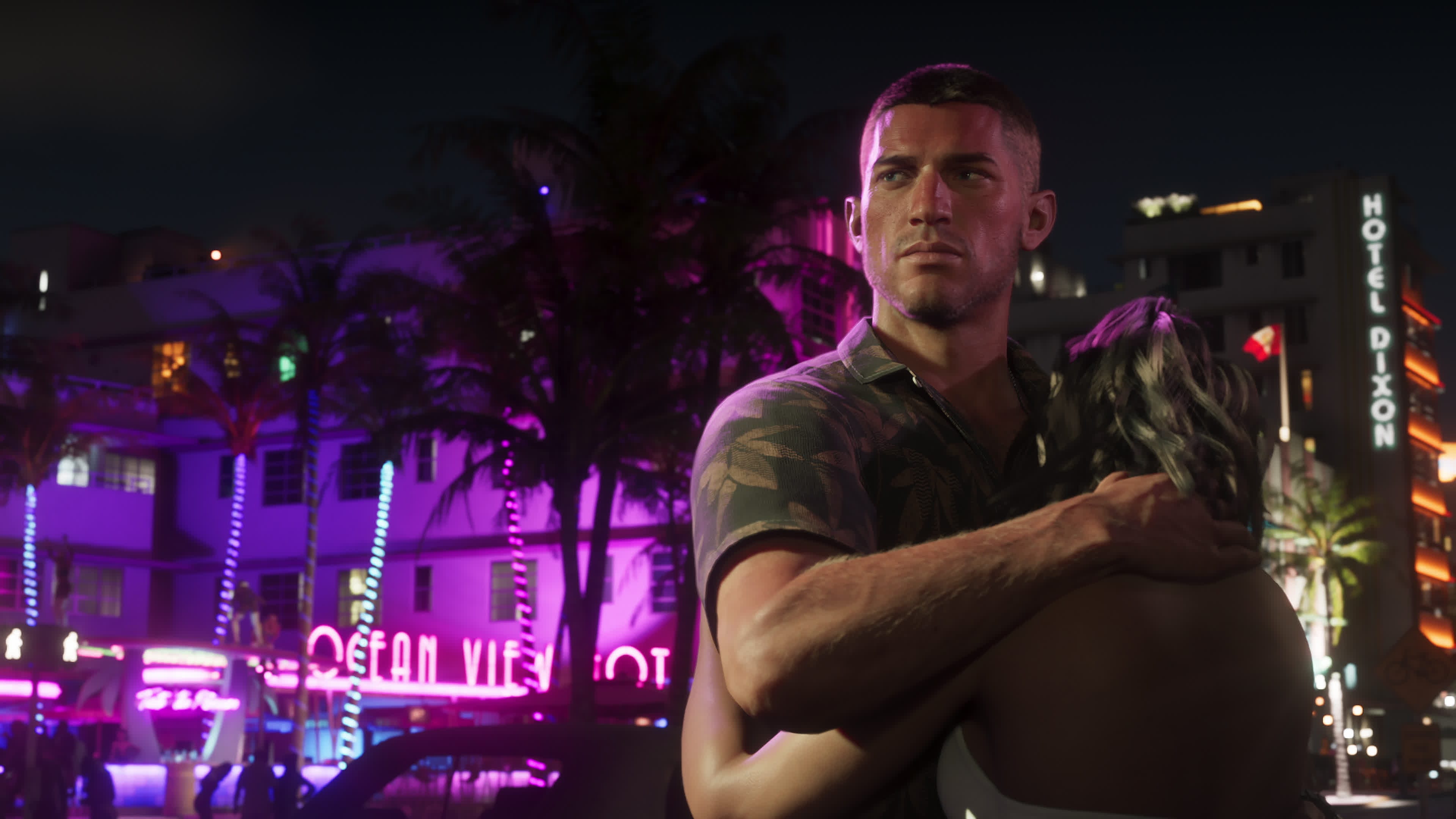
Trailer 2 Anatomy: Every Frame, Every Clue
A scene-by-scene editorial breakdown of GTA VI Trailer 2 - what Rockstar showed, what they implied, and what it means for the final game.
When Rockstar released the second Grand Theft Auto VI trailer on 6 May 2025, they showed the world a more complete picture of what the next chapter in their series would look like. The 2-minute, 47-second cut works as a sequel to December 2023's first trailer, but it's also a piece of communication in its own right - denser, more confident, and more specifically loaded with information about the game's themes than the reveal cut was.
This piece is an editorial breakdown rather than a frame-by-frame timestamp dump. We're interested in what Rockstar chose to show, what they chose to withhold, and the editorial decisions you can read between the cuts.
The opening: a thesis statement
Trailer 2 doesn't open with a city skyline or an action set-piece. It opens with Lucia Caminos in a quiet, almost domestic moment - establishing her not as a "playable character" but as a person with an interior life. This is consistent with how Rockstar opened Red Dead Redemption 2's reveal trailer with Arthur Morgan staring into a snowbound horizon, and inconsistent with the bombast of GTA V's reveal which led on Michael's swimming pool.
The framing tells you Rockstar wants you reading Lucia and Jason as characters, not avatars. That's a serious shift in how the studio has historically marketed protagonists, and it suggests an emphasis on narrative weight over open-world chaos as the trailer's core sell.
Vice City has been thoroughly modernised
The Vice City of Trailer 2 is unmistakably the same city as the 2002 game's setting, but it's been forty years. The Art Deco is still there, the neon is still there, the long beach drives are still there - but they're now layered with the apparatus of 2026: TikTok-style influencers in beach scenes, modern phone interfaces in the driving HUD, contemporary fashion. The brand language of Vice City has been preserved while the cultural language has moved on.
The bayside skyline shots are particularly worth pausing on. Rockstar's previous open worlds have had skylines that read as "tall buildings"; the Trailer 2 skyline reads as a specific, locatable city. You can see zoning - the Art Deco strip, the modern glass towers, the residential mid-rises. This is the visual vocabulary of a real city, not a video-game city, and it's one of the strongest signals about how dense the world simulation is going to be.
The ecology
Trailer 2 spends real screen time on Florida wildlife. We see alligators in marshland, a panther moving through palmettos, sharks visible from a boat, flamingos on a riverbank. This isn't decoration - Rockstar including ecological footage in their third minute of marketing is them telling you the wildlife layer matters.
Compare this to GTA V's reveal trailer, which had essentially zero animal footage. The closest precedent is Red Dead Redemption 2, which built its hunting and herbalism systems into a defining mechanical pillar. The presence of so many distinct species in Trailer 2 - and the way they're filmed (the panther moving through brush in real-time, not as a cinematic), suggests these aren't just spawn-once setpieces.
The "Bonnie and Clyde" framing is doing work
The romantic-criminal-couple framing that Trailer 2 leans into is unmistakably Bonnie and Clyde - and that reference matters because of where Rockstar usually pulls from. Their previous protagonist pairings have been thematic, not romantic: Michael / Trevor / Franklin in V were a tone study; Niko's relationship with Roman in IV was familial.
Lucia and Jason as a couple is new for the series. It's also a setup that constrains the story: their relationship is the through-line, which means missions can't just split them up into independent open-world chaos. It's much closer to RDR2's relationship-driven Dutch / Arthur arc than GTA V's "swap protagonists for variety" approach.
What Rockstar did NOT show
Equally interesting is what's missing from Trailer 2:
- No HUD beyond the driving phone. Rockstar usually gives you at least a glimpse of the mission marker / minimap / objective text language. Their absence here suggests the in-game UI isn't finalised, or that they want to control the unveiling.
- No dialogue from Jason that establishes voice. We hear Lucia's voice (continuing from Trailer 1's prison framing) but Jason is largely silent. This is a deliberate hold - voice is one of the strongest "this is who this character is" signals, and Rockstar is keeping their powder dry on his.
- No combat. There's gunfire visible in some cuts, but no extended combat sequence. GTA V and RDR2 trailers both showed combat at length. Holding it back here may simply mean the combat system isn't quite ready to show, or it may be deliberate signalling that this game leads with story over violence.
- No online mode. Not one frame. GTA V's second trailer didn't show online either - that came later. But it's a reminder that we know almost nothing about the structure or launch timing of GTA Online II.
Why this matters for the wait
Trailer 2 is dense enough that you can spend hours decoding it, but the editorial takeaway is simpler: Rockstar is positioning GTA VI as a more grown-up, more character-driven evolution of the series. The visual production value and the deliberate restraint are both consistent with a studio that knows it's making a generation-defining title and isn't trying to prove anything to anyone.
If the trailer reads as quieter than V's, that's the point. The pitch isn't "look how big the world is" - every Rockstar map for fifteen years has been the biggest in the industry. The pitch is "look how real the world is, look at these two people, watch what they do".
The question now is whether the final game can deliver on that framing. We have until November 19, 2026 to find out.
References to trailer footage are based on the public releases on Rockstar's official channels plus the official press-kit imagery at rockstargames.com/VI. We make no claim to inside information beyond publicly available material.
See guide locations on the map
Track your progress, open evidence, and mark locations as discovered.
Open live map